Lead Management Process: 8 Steps from First Enquiry to Closed Deal
A practical lead management process in eight steps, from capturing an enquiry to closing it with a recorded outcome, plus a checklist to find where your team loses leads.
By DigiPix Flow team
In this guide
Most sales teams already have a lead management process. It just isn't written down. It lives in how the senior rep works, in a WhatsApp group where enquiries get forwarded, and in a spreadsheet one person updates on Mondays. It works, until the senior rep goes on leave or enquiries double after a good campaign.
This guide sets out a lead management process in eight steps that a small or mid-sized team can run every day. Each step has a clear goal and a simple rule. At the end there is a checklist you can use to audit your current process in about half an hour.
The lead management process at a glance
| Step | Goal | Simple rule |
|---|---|---|
| 1. Capture | Every enquiry recorded in one place | No lead lives only in an inbox, a phone or a portal |
| 2. Clean up | One person, one record | Check phone and email for duplicates before anyone calls |
| 3. Assign | One owner per lead | Assigned within minutes, with a fallback owner |
| 4. Respond | First contact while the buyer is still interested | Call first; WhatsApp if the call isn't answered |
| 5. Qualify | Know who is worth your time | Need, timing, decision-maker and budget recorded |
| 6. Follow up | Nobody is forgotten | Every open lead has a dated next step |
| 7. Convert | Qualified leads become deals | Moved into the pipeline with a value and a stage |
| 8. Review | Learn and fix | Weekly overdue check, monthly source review |
Step 1: Capture every enquiry in one place
List every place a lead can come from. For a typical Indian SMB that might be Facebook and Instagram lead ads, Google Ads lead forms, the website contact form, IndiaMART, inbound calls, WhatsApp messages and walk-ins. Then decide how each one reaches your single list:
- Automatically where possible. Ad platforms and marketplaces can usually be connected to a CRM, so leads arrive without anyone copying them.
- A quick manual entry for the rest. Adding a call, a walk-in or a WhatsApp enquiry should take a rep less than a minute.
- Source always recorded. "Where did this lead come from?" should never be blank.
If Meta ads are one of your sources, our guide on following up Facebook and Instagram lead ads covers what to do in the first hours.
Step 2: Clean up duplicates before anyone calls
The same person often enquires twice: once from an ad, and again on WhatsApp a day later. If both become separate leads, two reps call, and the buyer wonders whether anyone at your company talks to each other. Check new leads against existing ones by phone number and email. Store phone numbers in one format, such as +91 followed by ten digits, so a match isn't missed because one entry has a space or a leading zero.
When a match is found, don't delete anything automatically. Flag it for a person to review and merge, because two enquiries from the same buyer can genuinely be for two different products.
Step 3: Assign each lead to one owner
Decide how leads are shared, and write it down. Common approaches include:
- Round robin: leads rotate through the team, one each.
- By product or service: the home-loan specialist gets home-loan enquiries.
- By language or city: a Tamil-speaking rep takes Chennai leads.
- By workload: the rep with the fewest open leads gets the next one.
Add two safety nets: a default owner for leads that match no rule, and a plan for leads that arrive outside working hours, so they are first in the queue the next morning.
Step 4: Respond while the buyer still remembers you
Speed is the step most teams underestimate. A buyer who enquired on IndiaMART or through a Meta ad has probably contacted other businesses too. Set a response target, for example within 15 minutes during working hours, and measure it. Our article The Lead Who Enquired With You Enquired With Three Others explains why the first reply matters so much.
Call first. If the buyer doesn't answer, send a short WhatsApp message that says who you are and what they enquired about, so your number isn't mistaken for spam.
Step 5: Qualify in the first real conversation
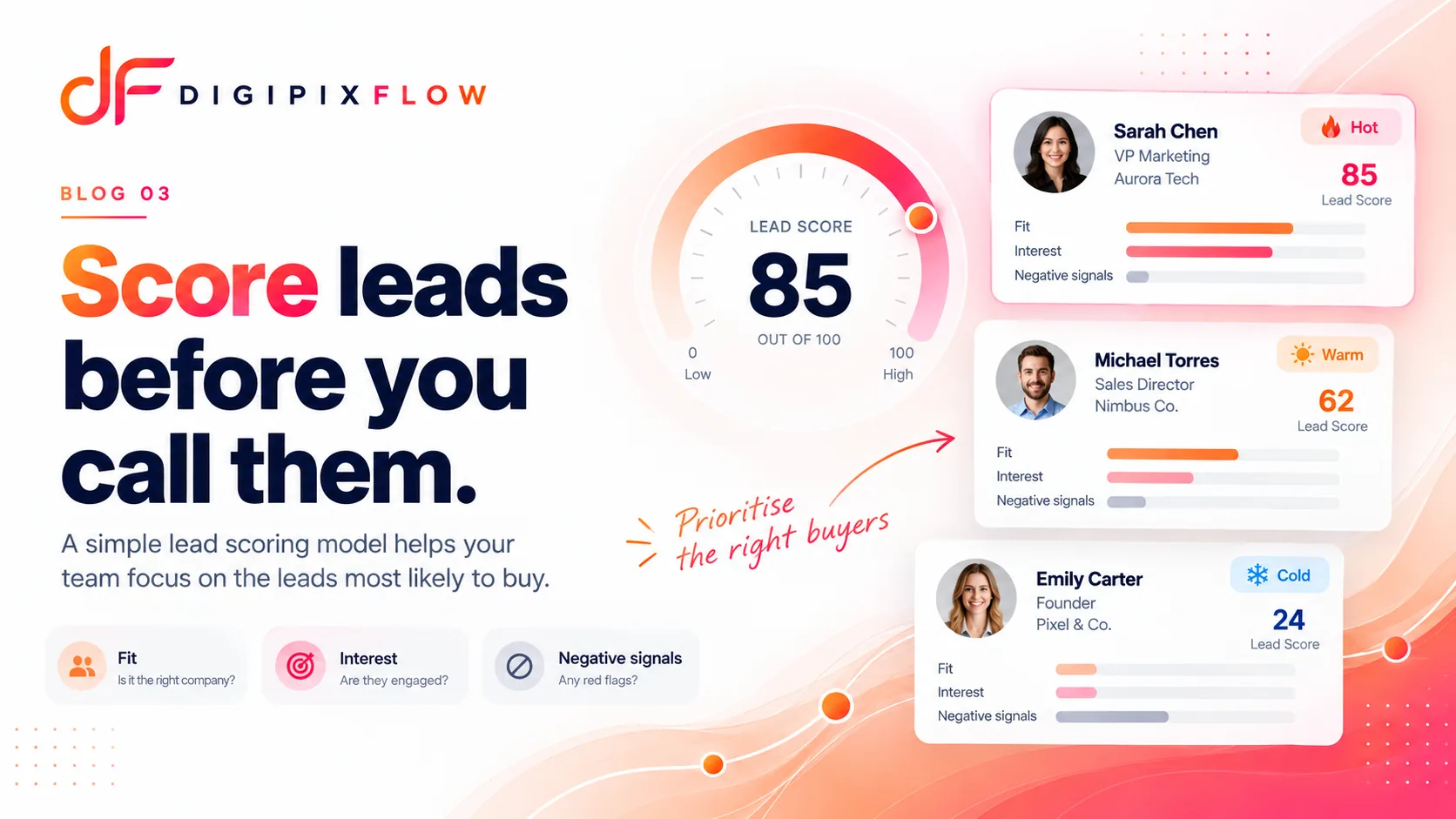
Use the first conversation to find out four things: what they need, when they want it, who decides and whether your price range fits. Record the answers in proper fields, not free-text notes, so leads can be filtered and prioritised later. Then give each lead a label, such as hot, warm, cold or not a fit, with a matching next step. If you want to rank leads before anyone calls them, a simple lead scoring model does exactly that.
Step 6: Follow up on a schedule, not from memory
Most sales need more than one conversation, and many buyers reply only on the second or third attempt. Two rules make follow-up reliable:
- No open lead without a dated next step. Every time a rep finishes a call or message, they set the next one: "Call Thursday 11:00" or "Send brochure today, check Monday".
- Overdue follow-ups are visible. A list of overdue follow-ups, checked daily by the team lead, catches whatever slipped.
For leads that go quiet, use a planned follow-up cadence, for example on days 0, 1, 3, 7 and 14, mixing calls, WhatsApp and email. Then move them to a monthly nurture list rather than deleting them. Our guide to WhatsApp follow-up messages has wording you can use.
Step 7: Convert qualified leads into deals
When a qualified lead asks for a quote, a demo or a site visit, it becomes a deal. Move it into your sales pipeline with an estimated value, an expected close date and a stage. From here the question changes from "is this a real buyer?" to "what has to happen for them to say yes?". Our guide to sales pipeline stages covers how to define those stages.
Close leads that won't convert, with a reason: not a fit, no budget, bought elsewhere, or no response after the full cadence. Those reasons are some of the most honest feedback your marketing will ever get.
Step 8: Review the process every week and month
A process that is never reviewed quietly drifts. Keep two short routines:
- Weekly (30 minutes): overdue follow-ups, unassigned leads, leads with no next step, and any lead that waited too long for its first reply.
- Monthly (1 hour): leads, qualified leads and customers by source; average first-response time; and the most common lost reasons.
Here is an example of what a monthly review can reveal. Say Meta ads brought 300 leads and 12 customers, while IndiaMART brought 80 leads and 9 customers. Meta looks bigger, but IndiaMART converts far better per lead, so it may deserve faster replies or a dedicated rep. These numbers are illustrative. Yours will be different, which is exactly why you review them.
Lead management process checklist
Use this checklist to audit your current process. Every "no" is a place where leads are probably leaking.
| Area | Check |
|---|---|
| Capture | Every lead source is listed, and each one reaches a single list |
| Capture | Every lead has its source recorded |
| Clean-up | New leads are checked for duplicates by phone and email |
| Assignment | Every lead gets one owner within minutes, with a fallback owner |
| Response | There is a written first-response target, and it is measured |
| Qualification | Need, timing, decision-maker and budget are recorded in fields |
| Follow-up | Every open lead has a dated next step |
| Follow-up | Overdue follow-ups are reviewed every day |
| Conversion | Qualified leads move into the pipeline with a value and a stage |
| Outcome | Lost leads are closed with a reason |
| Review | Sources are compared on customers, not just lead count |
Where DigiPix Flow fits
DigiPix Flow is built to run this process without spreadsheets. Leads from Meta Lead Ads, Google Ads lead forms, IndiaMART, website forms and imports arrive in one list with their source, are checked for duplicates, scored and assigned by your rules, and each new lead gets a first task. Follow-ups carry reminders and are escalated when overdue, deals move through the stages you define, and reports show leads by source.
Write it down, then make it a habit
The best lead management process is the one your team actually follows on a busy Monday. Write down the eight steps with your own rules, pin the checklist where everyone can see it, and review it every month. Small fixes to response time and follow-up usually pay off faster than any new campaign.
Frequently asked questions
What is a lead management process?
A lead management process is the set of steps a business follows for every enquiry, from capturing it to closing it as a deal or a lost lead. A typical process covers capture, removing duplicates, assignment, first response, qualification, follow-up, conversion and review.
What are the steps in the lead management process?
Eight steps work for most small and mid-sized teams: capture every enquiry in one place, check for duplicates, assign an owner, respond quickly, qualify the buyer, follow up on a schedule, convert qualified leads into deals, and review the results every week and month.
How do I know if my lead management process is working?
Watch four numbers: how quickly new leads are contacted, what share of leads are contacted at all, how many leads have an overdue follow-up, and how many customers each source produces. If these improve month on month, the process is working.
How many follow-ups should a lead management process include?
Plan for five or six attempts over about two weeks, mixing calls, WhatsApp and email, before moving a lead to a monthly nurture list. Many buyers reply only on a later attempt, so stopping after one call loses leads that were genuinely interested.
Who should own the lead management process?
One person, usually the sales manager or the founder, should own the process itself: the rules, the weekly review and the monthly source review. Each individual lead is then owned by the rep it is assigned to.
Can I run a lead management process without a CRM?
Yes, with a shared spreadsheet and strict habits, if you get only a few leads a week from one or two sources. As sources and team size grow, a CRM helps by collecting leads automatically, assigning them and reminding people about follow-ups.
Put this guide into practice
See qualification questions, lead scoring and follow-up built into one workspace, using your own lead sources.